A Practical Guide for Engineers, Manufacturers, and Procurement Teams
Polymers are at the core of modern manufacturing—but for many professionals, understanding the differences between polymer types and their industrial applications remains a challenge.
Whether you’re selecting materials for production, optimizing product performance, or sourcing materials, a lack of technical clarity can lead to costly mistakes.
This guide breaks down the types of polymers and their industrial uses in a clear, practical way—helping you make more informed decisions.
What Are Polymers?
Polymers are large molecular structures (macromolecules) composed of repeating units called monomers, formed through polymerization.
Their structure enables key properties such as:
- Strength and durability
- Flexibility or rigidity
- Chemical and heat resistance
- Lightweight performance
These characteristics make polymers a preferred alternative to traditional materials like metal and glass across industries.
Main Types of Polymers
Understanding polymer classification is essential for selecting the right material.
1. Polymers Based on Origin
Natural Polymers
Derived from biological sources:
- Cellulose
- Natural rubber
- Proteins
Synthetic Polymers
Engineered for industrial performance:
- Polyethylene (PE)
- Polypropylene (PP)
- Polyvinyl Chloride (PVC)
- Polyethylene Terephthalate (PET)
2. Polymers Based on Thermal and Mechanical Behavior
Thermoplastics
- Can be melted and reshaped multiple times
- Suitable for high-volume manufacturing
Examples: PE, PP, PVC, PET, PS, PC
Thermosetting Polymers (Thermosets)
- Permanently harden after curing
- High resistance to heat and stress
Examples: Epoxy, Polyurethane
Elastomers
- Flexible and elastic
- Return to original shape after stretching
Examples: Rubber, Silicone
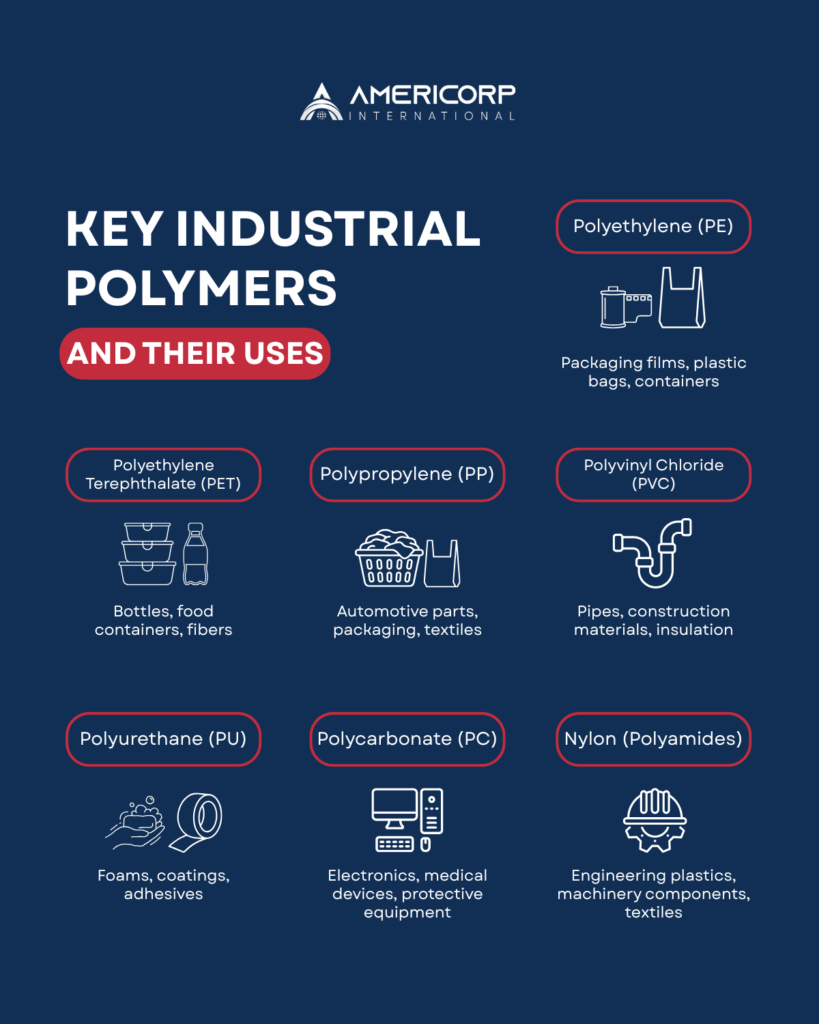
Industrial Applications of Polymers
Packaging Industry
- Bottles, films, containers
- Materials: PE, PP, PET
Automotive Industry
- Interior components, bumpers
- Materials: PP, PU, Nylon
Medical Industry
- Implants, tubing, devices
- Materials: Silicone, PE
Electronics Industry
- Casings, insulation
- Materials: PC, specialty polymers
Construction Industry
- Pipes, flooring, insulation
- Materials: PVC, PU
Bridging the Knowledge Gap
A lack of understanding in polymer selection can lead to:
- Inefficient production
- Increased costs
- Product performance issues
By understanding polymer types and their applications, companies can improve both operational efficiency and product quality.
Conclusion
Polymers are essential to modern industry due to their versatility, durability, and cost efficiency.
Selecting the right polymer type is not just a technical decision—it’s a strategic one that impacts performance, cost, and scalability.
About Americorp International
Americorp International supports manufacturers with high-quality polymer solutions and technical expertise tailored to industrial applications in the U.S.
👉 Contact our team to find the right material solution for your application.